



The Definition of Debris Flow
 What the Video Tells Me
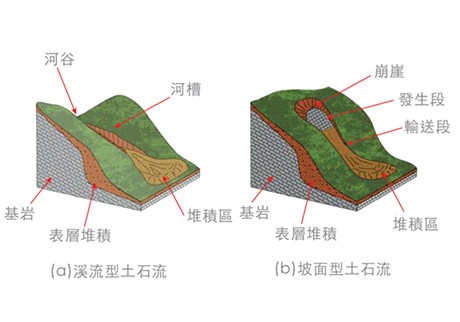
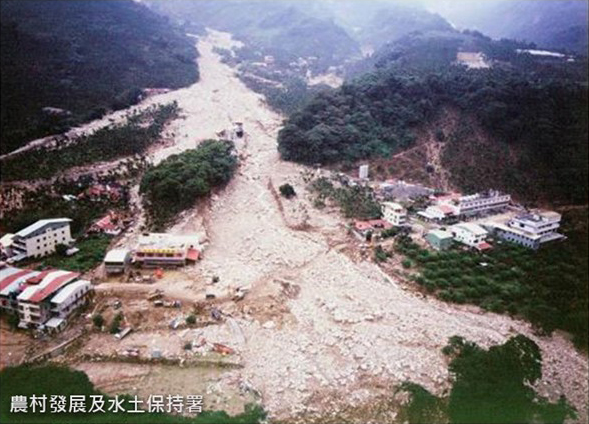
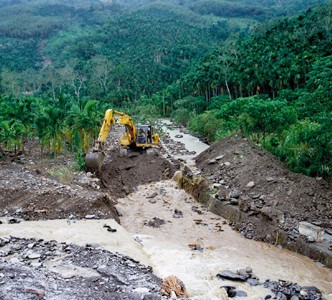
The movement pattern of debris flow can be divided into the source area, the flow path, and the deposition area. The cross-section of the source area is mostly V-shaped, and the debris from the collapsing valley walls accumulates heavily here, so the surrounding vegetation often appears sparse. The flow path is U-shaped, usually located in the middle and lower reaches of mountain ravines and river valleys, where the riverbed contains debris that has collapsed from the river banks on both sides. The deposition area is mostly at the downstream outlet of the stream, often forming a flat alluvial fan-like terrain. The surface and front edge are often accumulated with massive rock blocks, and the whole looks like an elongated tongue.
The Definition of Debris Flow Disaster
 Further Reading
- In Taiwan, debris flow mostly occurs in mountainous or valley areas during heavy rainfall. Its appearance is extremely similar to commonly seen concrete mortar, hence it is also likened to 'natural ready-mix concrete'.
- debris flow is a special form of soil erosion, often appearing simultaneously with or delayed after other erosion forms such as Landslide or slope failure (Debris Flow General Theory 2003).
- debris flow is a high-concentration and fast-moving 'two-phase flow' consisting of a mixture of mud, sand, gravel, and massive rocks with water. The movement is primarily governed by gravity, with water flow as a secondary factor. It has a visible or at least identifiable channel (gully), and its downstream side often has a tongue-shaped or ear-shaped sedimentation section, with massive rocks accumulated at the forefront of the sedimentation section. (Soil and Water Conservation Manual 2017)
- A large wave-like movement that flows down the river valley, carrying many solid and fluid components. During movement, a small portion of the wave moves faster and covers the flowing earth and stones ahead, causing continuous overlapping. (Johnson, A. M., Rodine, J. R. 1984)
- debris flow is the collective transport of earth and stones mixed with rainwater into a fluid, which contains large gravel, fine sand, drift wood, etc., and moves downwards with rolling, sliding, and hopping, with the large gravel at the head. (Zhang Lixian 1985)
- debris flow is a mixture of earth and stones with water, and its movement pattern is collective transport; it is different from the individual transport of water scouring the river banks or the erosion/deposition of the riverbed. (Huang Hongbin 1991)
- debris flow is the phenomenon of weathered soil, colluvial deposits, or streambed deposits rapidly flowing down a slope or streambed after becoming saturated with water. (Zhang Shijiao 1995)
- debris flow is a high-concentration water-sand mixed 'two-phase flow', which has a leading edge (forefront) concentrated with a large amount of earth, sand, and gravel, and is a fluid mass moving at high speed in the form of surge waves. (Lian Huibang 1996)
- Earth and rock or mud deposited in the streambed or river valley after a Landslide, when subjected to heavy rainfall or streambed runoff, the deposit forms a highly water-saturated, viscous liquid that collapses down the slope. (Hong Mingrui 1998)
